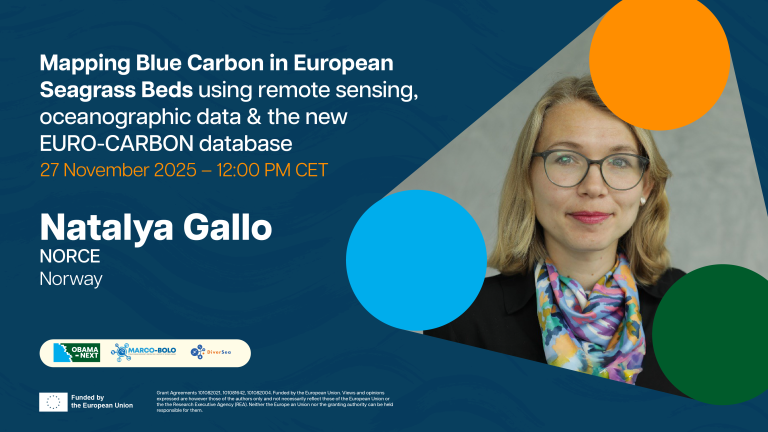
Can we generate European-wide carbon stock estimates for seagrass meadows using a combination of readily available oceanographic and remote sensing data products? That is the question underlying this MARCO-BOLO study on blue carbon mapping. Despite covering a small fraction of the Earth’s surface, “blue carbon” ecosystems such as seagrass meadows bury carbon at disproportionately high rates, making them relevant to climate mitigation. Seagrasses meadows are found along many European coastlines but are rarely included in national emission inventories, in part due to the challenge of mapping seagrass habitats and estimating carbon stocks. We examine whether relevant data products from Copernicus and NASA can be used to explain variation in organic carbon stocks in European seagrass meadows. Since most organic carbon in a seagrass bed is stored in the underlying sediments (>98%), we used the new EURO-CARBON database of sediment organic carbon data (including 4000+ seagrass measurements) for model development. We found high model explanatory power across a suite of tested models (R2 > 0.8) and will discuss key environmental predictor variables that were identified. Policy needs for reporting carbon stocks are growing, and the talk will conclude with an overview of a virtual research environment (in development) that will allow users to predict carbon stocks in a European seagrass bed of interest.
Her research explores how climate change impacts deep-sea ecosystems, with a focus on blue carbon, ocean deoxygenation, and sustainable ocean management. Natalya holds a PhD from the Scripps Institution of Oceanography at UC San Diego, where she studied the effects of low-oxygen zones on deep-sea fish communities.
She has contributed to multiple Horizon Europe projects, including OceanICU and MARCO-BOLO, and is deeply engaged in the science-policy interface, having participated in several UN climate and ocean conferences.
In 2019, she gave a TEDxUCSD talk on the importance of ocean oxygen and its role in sustaining marine life, highlighting the urgent need for climate action.