

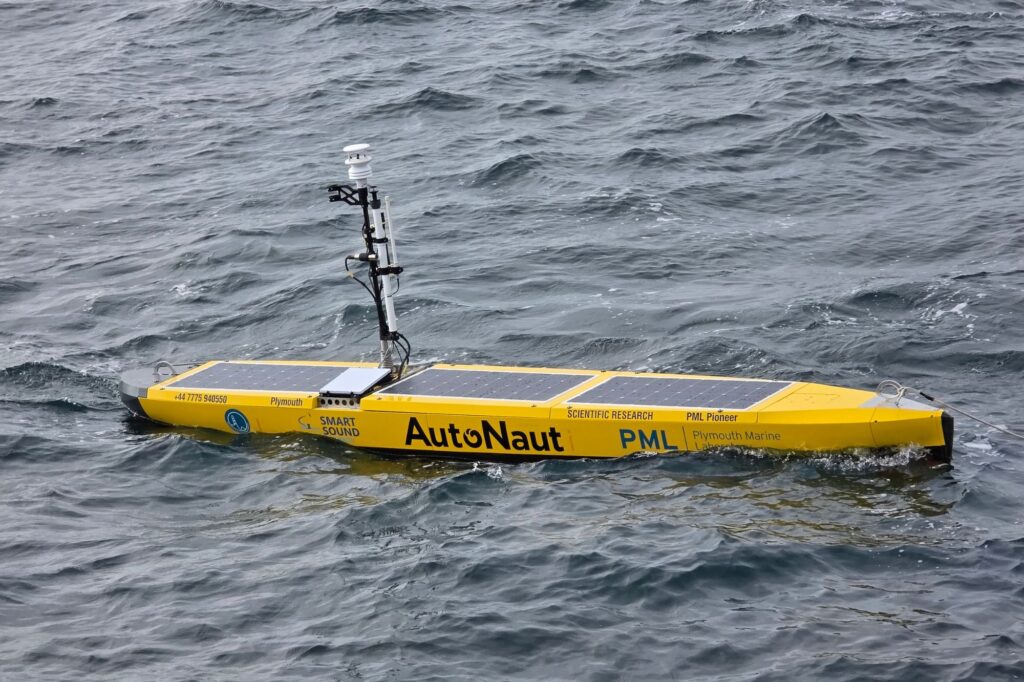
MARCO-BOLO partners Plymouth Marine Laboratiry (PML) and the National Oceanography Centre (NOC) joined forces to complete a successful sampling campaign in the Plymouth Sound by deploying the uncrewed surface vessel (USV) AutoNaut ‘Pioneer’.
Autonomous measurements provide a cost-effective opportunity to study the marine environment in detail, whilst also providing a real opportunity to deliver a net-zero oceanographic capability. The PML Pioneer is a five-metre AutoNaut USV propelled by wave motion and powered by three hundred-watt solar panels. The integrated scientific payload is the most advanced to be deployed from an AutoNaut, with a range of state-of-the-art sensors that collect data autonomously as it self-navigates the ocean. During its time spent sampling – 26 hours over 4 days – in the Plymouth Sound, the AutoNaut autonomously collected plankton images with a UVP-6 Plankton Imager, and environmental DNA (eDNA) samples were triggered intelligently by real-time chlorophyll concentrations with a RoSCI eDNA sampler.
PML’s Professor James Fishwick (Head of Smart Sound Plymouth and Head of Operations and Technology, Western Channel Observatory) said:
“This mission showcases how autonomous technologies can revolutionise the way we study our marine environments – we can only protect what we understand. By integrating real-time sensing with biodiversity sampling, we can capture vital data on ecosystem changes with greater precision and frequency. This latest PML and NOC mission contributes to MARCO-BOLO’s efforts to validate and refine the use of eDNA for biodiversity assessment, developing tools and technologies that will form part of a sustainable, long-term observation network to support the biodiversity of European waters.”
It is thought that this is the first time a RoSCI eDNA sampler has ever been deployed on an autonomous surface vessel in Europe. This innovative approach reinforces the potential for autonomous systems to carry out complex biodiversity monitoring tasks efficiently and with minimal human intervention. The deployment was a milestone in MARCO-BOLO’s Work Package (WP) 4: Mapping Biodiversity with Autonomous Systems, which aims to enable new and advanced technologies for biodiversity observations in coastal and marine regions.
Dr Julie Robidart (Head of Ocean Technology and Engineering at NOC, and MARCO-BOLO WP4 Lead) commented:
“This demonstration combines non-invasive, multi-sensor biodiversity observations with the AutoNaut wave-powered vehicle, to provide carbon-neutral, detailed maps of coastal ecosystems. It furthers the state of the art by using networked sensor data streams to decide where and when to sample, without human interaction. Smart technologies like these can decrease power requirements, thus increasing endurance of autonomous systems.”
Watch the AutoNaut in action!
To learn more about their sampling campaign, please visit this page.
This article was originally published by PML on their website, images and footage provided by PML.